Artificial intelligence has transformed how people interact with technology, evolving from simple automated responders into responsive conversational partners. While many individuals initially explore an AI friend chatbot to pass the time, millions of learners have discovered a far more impactful application: language acquisition.
An AI companion provides a low-pressure, on-demand environment where you can practice speaking, refine grammar, and expand vocabulary without the social anxiety that often accompanies practicing with human conversation partners. However, not every conversational bot delivers the structured guidance needed to achieve fluency or prepare for high-stakes standardized exams. Finding the best AI companion requires understanding how conversational AI bridges the gap between casual chatting and structured English tutoring.
The Evolution: From Casual Chat to Dedicated AI English Tutor
Early conversational agents were often designed as simple entertainment tools—interactive bots built to simulate casual banter. While chatting with a general-purpose conversational model can build basic typing speed and comfort, it rarely corrects subtle grammatical errors, trains pronunciation, or evaluates discourse structure.
According to research into top AI language learning applications, modern language companions have transitioned into speaking-first, feedback-oriented tutors. Instead of simply generating open-ended replies, specialized AI language platforms analyze phonetic accuracy, track lexical diversity, and identify recurring syntactic mistakes.
This transformation solves one of the biggest hurdles in language education: speaking anxiety. Traditional classroom settings or private tutoring sessions can make learners self-conscious about making errors. Practicing with a dedicated AI companion eliminates judgment, allowing users to make repeated attempts, test new idioms, and master conversational rhythm at their own pace.
What Makes an AI Language Companion Truly Effective?
To deliver real educational value, an AI English tutor must offer more than superficial conversation. A robust platform should feature:
- Real-Time Pronunciation and Fluency Feedback: The companion should detect pauses, intonation shifts, and mispronounced phonemes, giving actionable guidance on how to speak clearly.
- Contextual Grammar and Vocabulary Corrections: Rather than simply offering generic suggestions, the system should pinpoint awkward phrasing and suggest natural, native-level alternatives.
- Structured Learning Scenarios: Roleplaying everyday situations—such as job interviews, workplace presentations, or academic debates—helps bridge theory and practical application.
- Actionable Progress Tracking: As highlighted in industry assessments of AI English speaking tutors, measurable progress loops with diagnostic metrics are essential for long-term skill retention.
While open-ended conversation builds confidence, learners preparing for professional milestones or international study require precision that general chatbots cannot provide.
Moving Beyond Casual Chat to Standardized Exam Readiness
For learners targeting international immigration, university admissions, or global employment, casual conversation is only the first step. Standardized language assessments—such as IELTS and TOEFL—evaluate candidates against strict institutional criteria established by organizations like ielts.org.
In these examinations, candidates are evaluated across specific parameters:
- Fluency and Coherence: The ability to speak smoothly, organize thoughts logically, and maintain speech without unnatural hesitation.
- Lexical Resource: Using a varied, precise, and natural range of vocabulary and collocations.
- Grammatical Range and Accuracy: Constructing complex sentences correctly with minimal systematic errors.
- Pronunciation: Speaking clearly with natural rhythm, word stress, and intonation patterns.
A generic chat interface cannot tell you whether your spoken monologue satisfies a Band 7.5 descriptor or where your written argument lost coherence. That is where exam-aligned platforms step in.
Targeted Preparation with acsent.ai
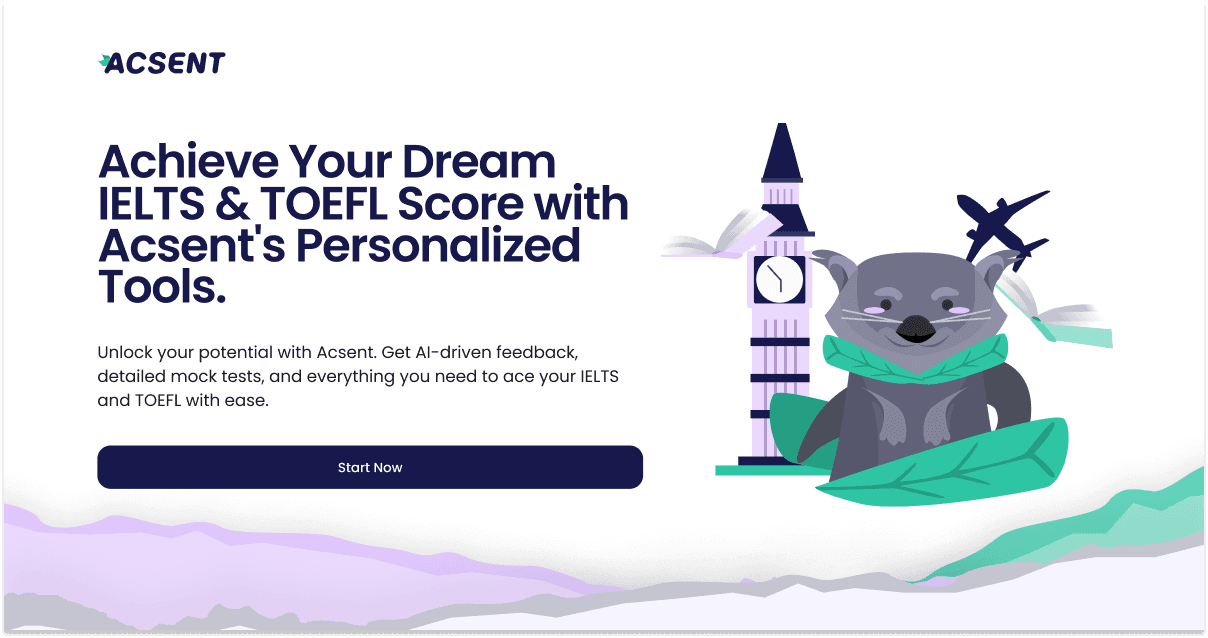
When you need an AI study partner designed specifically for academic and professional goals, acsent.ai bridges the gap between self-study and professional coaching. Used by over 10,000 students across 50+ countries, acsent.ai provides an AI-driven preparation environment for IELTS and TOEFL candidates.
Instead of providing simple answer keys, acsent.ai simulates official test conditions and applies AI scoring algorithms trained on official marking criteria:
- AI-Scored Speaking Practice: The dedicated Speaking Hub allows you to complete IELTS Part 1, Part 2 cue cards, and Part 3 discussion prompts. You receive instant band score estimates along with granular feedback on pronunciation, fluency, and lexical choice. Try AI-powered IELTS Speaking practice at acsent.ai.
- Comprehensive Writing Evaluation: Submitting essays for Writing Task 1 and Task 2 yields immediate diagnostic reports detailing Task Achievement, Coherence & Cohesion, Lexical Resource, and Grammatical Range & Accuracy. Get instant AI feedback on your IELTS Writing at acsent.ai.
- Full Mock Test Simulations: Practice under timed conditions across Listening, Reading, Writing, and Speaking to build pacing and stamina before exam day. Take a free IELTS mock test at acsent.ai.
By delivering objective scoring and targeted corrections, acsent.ai functions as an intelligent study companion that shows you exactly why you received a specific band score and how to improve it.
How to Maximize Your Practice with an AI Companion
To get the most out of your AI learning sessions, structure your practice routine with clear objectives:
1. Alternate Between Free Conversation and Structured Prompts
Begin your daily session with 5 to 10 minutes of spontaneous conversation with an AI partner to warm up your vocal muscles and build fluid thinking in English. Then, transition to structured, topic-specific prompts—such as answering abstract questions or summarizing complex articles.
2. Focus on One Weakness at a Time
When reviewing AI feedback, do not try to fix every mistake simultaneously. If your analysis indicates weak lexical variety, dedicate several sessions to incorporating collocations and idiomatic phrases. If grammatical accuracy is your main bottleneck, focus on complex sentence structures and subject-verb agreements.
3. Record, Review, and Repeat
Effective learning relies on iterative feedback. When an AI tool flags mispronunciations or awkward phrasing, re-record your answer immediately using the suggested corrections. Repeating the prompt correctly helps lock in muscle memory and speech patterns.
Choosing the Right AI Companion for Your Goals
The ideal conversational AI depends entirely on your personal objectives. If your goal is simply to build daily conversational habits, interacting with a friendly chatbot can reduce intimidation and keep you engaged. However, if your ambition is to pass an international proficiency exam, secure a university placement, or advance your career, you need an intelligent platform that evaluates your performance against rigorous, real-world standards. Combining conversational practice with targeted platforms like acsent.ai ensures that your daily practice translates into measurable, lasting English proficiency. Practice for free at acsent.ai.